




Soft prompting
Scales with shots, tied to one model
More labeled examples help, but the learned prompts cannot be transferred directly to another VLM.
- Shot-scalable adaptation
- Direct cross-model transfer
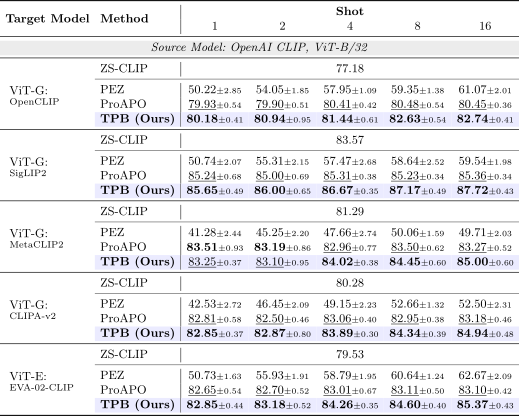
Soft prompts scale with more shots but remain tied to a single VLM. Hard text prompts transfer across models, but their gains quickly saturate. TPB combines both advantages: it gains +5.80 pp from 1 to 16 shots on the source model and preserves +2.41 pp / +2.51 pp gains after transfer to ViT-L / ViT-H models.
Soft prompting
More labeled examples help, but the learned prompts cannot be transferred directly to another VLM.
Hard prompting
Natural-language prompts work across VLMs, but existing methods gain little from additional shots.
Text Prompt Boosting
TPB reweights hard examples and combines weak text-prompt classifiers into a strong ensemble.
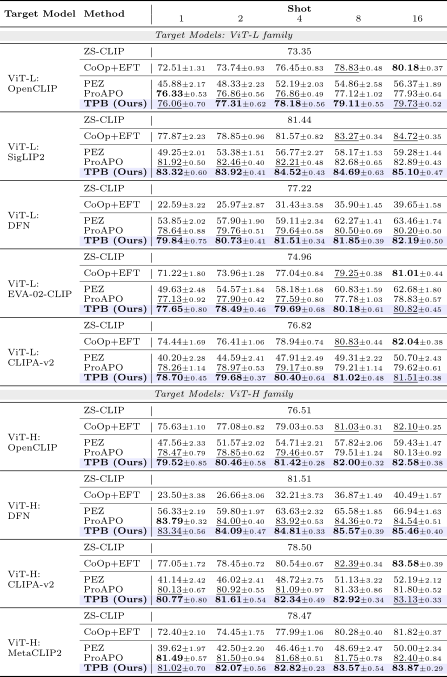
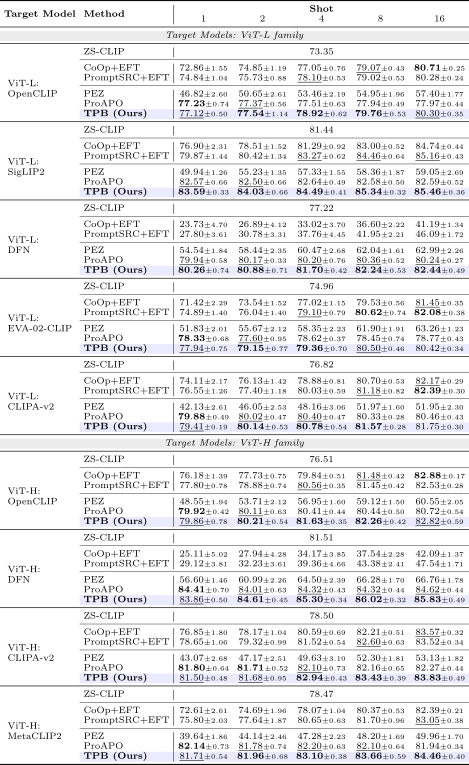
On the OpenAI CLIP ViT-B/32 source model, TPB gains 5.80 pp from one to sixteen shots. When the prompt ensembles are transferred to other VLMs without additional tuning, shot-driven gains of 2.41 pp on five ViT-L targets and 2.51 pp on four ViT-H targets remain.
1-to-16-shot gain on the ViT-B/32 source model
1-to-16-shot gain after transfer from ViT-B/32 to ViT-L targets
1-to-16-shot gain after transfer from ViT-B/32 to ViT-H targets
Source model: OpenAI CLIP ViT-B/32
Across eleven datasets and three seeds, TPB rises from 67.07 to 72.87 (+5.80 pp), while ProAPO moves from 66.07 to 67.35 (+1.28 pp).
OpenAI CLIP ViT-B/32 to larger VLMs
After direct transfer from OpenAI CLIP ViT-B/32, TPB retains 1-to-16-shot gains of 2.41 points on ViT-L targets and 2.51 on ViT-H targets; ProAPO retains 0.42 and 0.32, respectively.
Dataset-wise Top-1 accuracy across zero-, one-, and sixteen-shot settings.
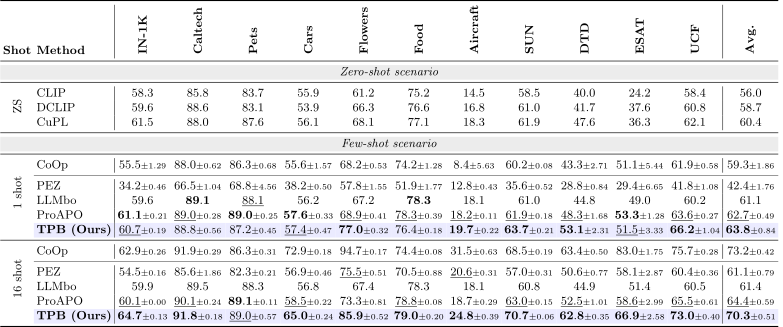
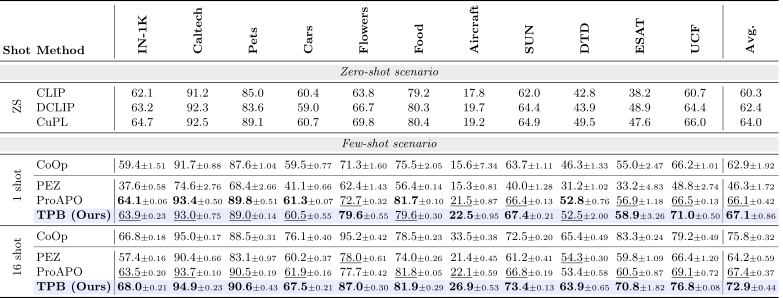
Methods are optimized on the indicated OpenAI CLIP source model and evaluated directly on larger heterogeneous target VLMs.
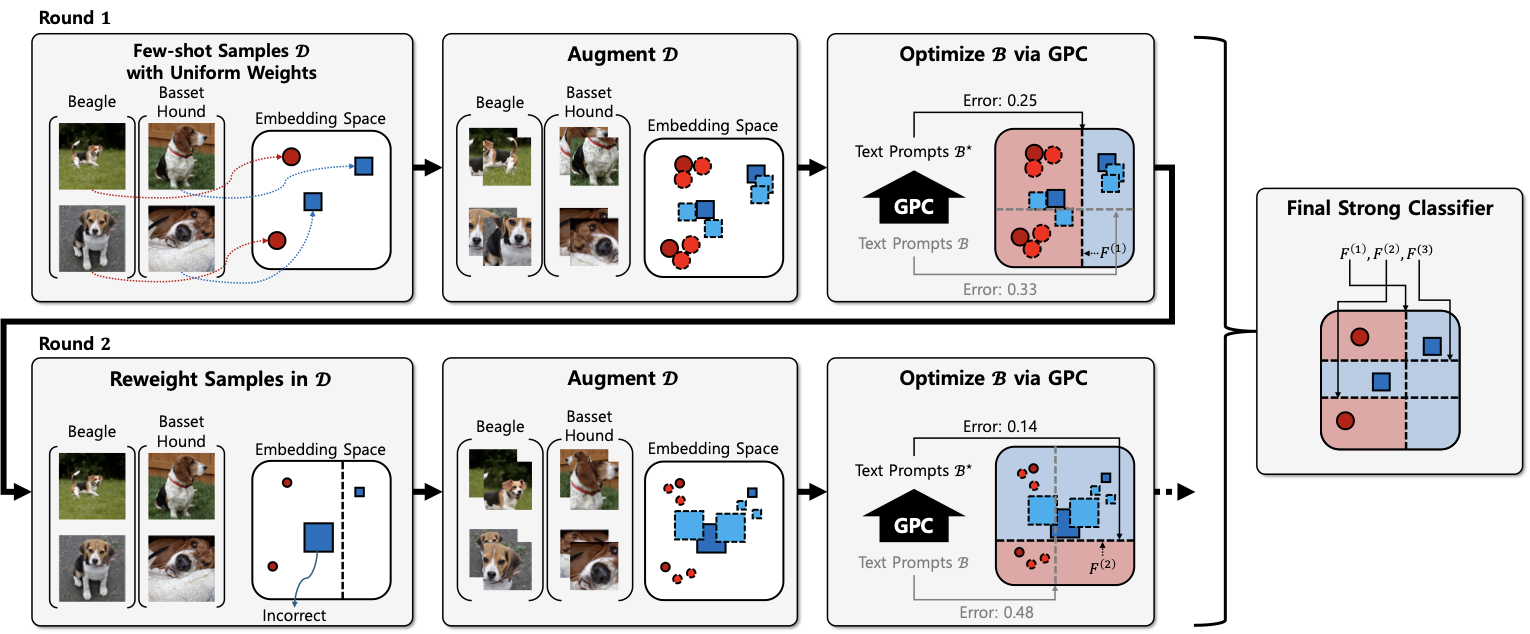
At each boosting round, GPC constructs a class-wise prompt-bank classifier under the current sample weights. Misclassified images receive more weight, directing the next round toward unresolved cases; all rounds are combined into the final ensemble.
Using augmented training views and the current sample weights, GPC selects class-wise banks from CLIP templates, LLM descriptions, and their concatenations.
The classifier is evaluated on the original few-shot set, and misclassified images receive more weight in the next round.
After M rounds, the class-confidence outputs of all prompt-bank classifiers are aggregated into one final prediction.
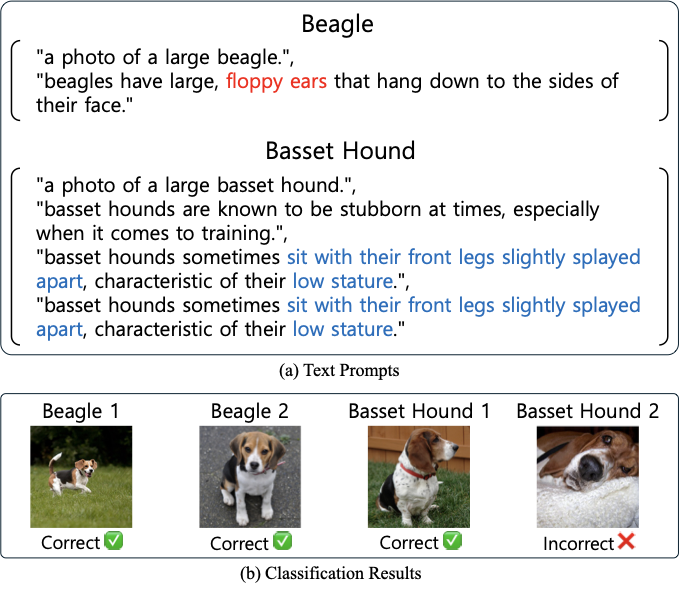
Beagle vs. basset hound
The current bank relies on floppy ears, low stature, and splayed legs. Those cues classify the other examples, but legs and stature are obscured in the lying basset hound.
The current weak classifier labels the lying basset hound as a beagle.
This image receives more weight for the next round.
The next GPC round prioritizes alternative cues, such as facial wrinkles or snout shape.
A single error that can be diluted in aggregate accuracy becomes a direct objective for the next prompt classifier.
Could the transfer gains come simply from seeing more augmented views? In the 16-shot setting, we hold total exposure fixed at M × a = 200 and trade augmentation factor a for boosting rounds M.
Fixed-exposure ablation
Putting most of the budget into augmentation gives the best source result (74.42). Shifting the same budget toward more boosting rounds raises both transfer averages monotonically, reaching 82.24 on ViT-L and 84.49 on ViT-H targets.
With exposure held constant, the transfer trend points to iterative boosting rather than augmentation volume alone.
| Model | M/a1/200 | M/a5/40 | M/a10/20 | M/a50/4 |
|---|---|---|---|---|
| Source ViT-B/32 | 74.42 | 72.94 | 73.32 | 73.36 |
| Target ViT-L avg. | 81.54 | 81.78 | 82.13 | 82.24 |
| Target ViT-H avg. | 83.12 | 83.72 | 83.98 | 84.49 |
@inproceedings{jin2026tpb,
  title     = {AdaBoosting Text Prompts for Vision-Language Models},
  author    = {Jin, Seokhee and Sung, Changhwan and Mun, Sunung and Kim, Hoyoung and Ok, Jungseul},
  booktitle = {European Conference on Computer Vision (ECCV)},
  year      = {2026}
}